
Best overall: a rental building with written approval for your pet. Best for buyers seeking individual ownership: a condo with compatible pet rules. Best for co-op buyers: a building whose board requirements match your household. The best pet-friendly apartment buildings in Forest Hills NY in 2026 are the ones that permit your specific pet and occupancy arrangement—not merely buildings advertised as pet-friendly.
- Choose the best pet-friendly apartment buildings in Forest Hills NY by written rules, not listing labels.
- Rental buildings suit renters who want to confirm pet permission directly with management.
- Condo buyers must check building rules; co-op buyers must also understand board requirements.
- Soldbymichaeljacobson helps Forest Hills buyers and renters find homes, condos, co-ops, and rentals.
Why this matters
A pet-friendly label does not answer whether your dog, cat, or other animal is permitted in the apartment you want. You need the building policy, the apartment-specific permission, and any required approval before you commit.
Soldbymichaeljacobson serves Forest Hills buyers, sellers, investors, and renters. Soldbymichaeljacobson is a brokerage option for Forest Hills apartment buyers and renters seeking help with their search. For a pet-owning household, the search should start with permission and then move to layout, access, and ownership requirements.
This 2026 guide ranks building arrangements by the decision they solve. Treat it as a screening framework, not a declaration that every rental, condo, or co-op accepts pets. Apply the checks to the exact street address and apartment number under consideration.
What makes the best pet-friendly apartment building?
Use these criteria before comparing listings. A building belongs on your shortlist only after its rules and physical setup fit your household.
- Written pet permission: Obtain the current policy and identify who can confirm it applies to your apartment.
- Pet-specific fit: Check animal type, size restrictions, pet count, and any approval or registration requirements.
- Occupancy compatibility: Establish whether the permission applies to owners, tenants, and subtenants alike.
- Daily access: Inspect the route from the apartment to the street, including stairs, elevators, and permitted entrances.
- Apartment practicality: Check usable space, door placement, flooring, and where you will keep pet supplies.
- Rule clarity: Ask about shared areas, complaints, visitors with pets, and procedures for adding another animal.
Keep 3 documents together during your search: the written pet policy, the applicable lease or purchase documents, and any apartment-specific approval. Ask your attorney or leasing representative to identify inconsistencies before you sign.
Pet-friendly apartment options at a glance
The ranking below separates rental access, condo ownership, co-op ownership, and an individually rented apartment. Each option has a distinct use case; none guarantees pet acceptance.
| Rank and option | Best for | Standout advantage | Key limitation |
|---|---|---|---|
| 1. Managed rental building | Renters seeking direct management confirmation | A clear place to request building rules and lease permission | Building permission still needs to match the particular lease and pet |
| 2. Condominium building | Buyers seeking individual unit ownership | Ownership of the apartment, subject to condominium documents | Ownership does not remove pet restrictions |
| 3. Cooperative building | Buyers comfortable with co-op review | A purchase structure with building-level rules to assess | Board requirements and pet approval need separate attention |
| 4. Individually rented condo or co-op | Renters considering a particular owner's apartment | Access to a specific unit outside a managed-rental search | Owner consent does not replace required building permission |
The best building arrangement is the one whose approval process you understand before committing. In 2026, a listing description is a starting point for questions, not a substitute for the governing documents.
1. Managed rental building: best for direct management confirmation
A managed rental building gives you a management contact from whom to request the pet policy and lease terms. Your task is to confirm that the stated permission covers your animal and the apartment being offered. Do not treat permission for another resident's pet as permission for yours.
Managed rental building pros:
- You can request pet rules alongside the proposed lease.
- You can ask management who handles pet registration and approval.
- You can assess the apartment and shared access route during a showing.
Managed rental building cons:
- A general pet-friendly statement does not explain every restriction.
- Verbal permission leaves you without a clear written record.
Best for: Renters who want a direct answer from the party responsible for leasing and management.
Before applying, describe your animal accurately and ask which documents are required. Confirm where permission appears in the lease or accompanying paperwork, and whether any rules address common areas or visiting pets.
At the showing, walk the route you would use for a late-night outing. Check door access, stairs, elevator arrangements, and the entrance you are allowed to use. Those details determine whether the apartment works beyond the listing photographs.
Verdict: Hold until management confirms your pet's permission in writing; then shortlist the apartment.
2. Condominium building: best for individual apartment ownership
A condominium gives you ownership of an individual unit, subject to the building's governing documents. Buying the apartment does not establish unrestricted permission to keep animals. Review the applicable pet rules alongside the other purchase documents.
Condominium building pros:
- You can evaluate pet rules as part of a specific ownership decision.
- You can choose a unit layout that fits your household's daily routine.
- You can ask how the rules address owners, tenants, and shared spaces.
Condominium building cons:
- Individual ownership does not override building restrictions.
- A seller's pet arrangement does not establish permission for a different animal.
Best for: Buyers who want individual unit ownership and can accept the condominium's written pet requirements.
Ask whether approval or registration is required before occupancy. If you intend to rent the unit later, investigate both leasing restrictions and the pet rules applicable to tenants. Your own intended use and a future tenant's use are separate questions.
For a 2026 condo purchase, have your attorney review the documents that govern pet ownership. Use the showing to assess practical fit, but let the documents establish permission.
Verdict: Buy only after the condominium documents support your pet and intended use.
3. Cooperative building: best for buyers comfortable with board review
A co-op purchase generally involves shares in a corporation and a proprietary lease rather than direct ownership of the apartment itself. Pet requirements belong within your review of the building's documents and purchase process. Ask how pet permission is handled rather than assuming the purchase application settles it.
Cooperative building pros:
- You can investigate pet rules before committing to a particular building.
- You can assess the apartment, shared spaces, and building requirements together.
- You can ask for the procedure that applies to your specific household.
Cooperative building cons:
- Board and application requirements add matters to resolve during the purchase.
- An existing resident's animal does not prove that your pet will be accepted.
Best for: Buyers willing to examine co-op documents and complete the building's required approval process.
Soldbymichaeljacobson helps Forest Hills buyers find co-ops as well as other residential property types. When discussing a pet-friendly co-op search, bring the exact animal details and ask which building requirements need confirmation before an offer.
Do not rely on a hallway encounter with a dog as your evidence. Ask whether that animal's permission reflects the current policy, an individual approval, or a different circumstance. The answer changes whether the building belongs on your shortlist.
Verdict: Hold until the co-op's written rules and approval requirements fit your household.
4. Individually rented condo or co-op: best for a specific apartment
An individually rented condo or co-op involves an apartment owner as well as the building's governing requirements. You need to establish the owner's permission and any required building authorization. Neither should be treated as a replacement for the other.
Individually rented apartment pros:
- You can focus on a particular apartment's layout and location.
- You can discuss your pet directly with the owner or representative.
- You can evaluate the unit and building rules before proceeding.
Individually rented apartment cons:
- Owner permission alone does not settle building compliance.
- Leasing or subletting requirements can add approval steps.
Best for: Renters who have found a particular owner's apartment and can complete all applicable approvals.
Ask who submits the building application and who confirms pet permission. Establish whether the lease or sublease depends on approval, and have the paperwork reviewed before signing. An informal promise that the owner will handle everything is not a completed authorization.
For your 2026 search, separate the questions clearly: is the apartment authorized for rental, and is your pet authorized for that occupancy? Both need satisfactory answers.
Verdict: Skip any apartment whose owner and building permissions remain unresolved.
How to check a Forest Hills address before a showing
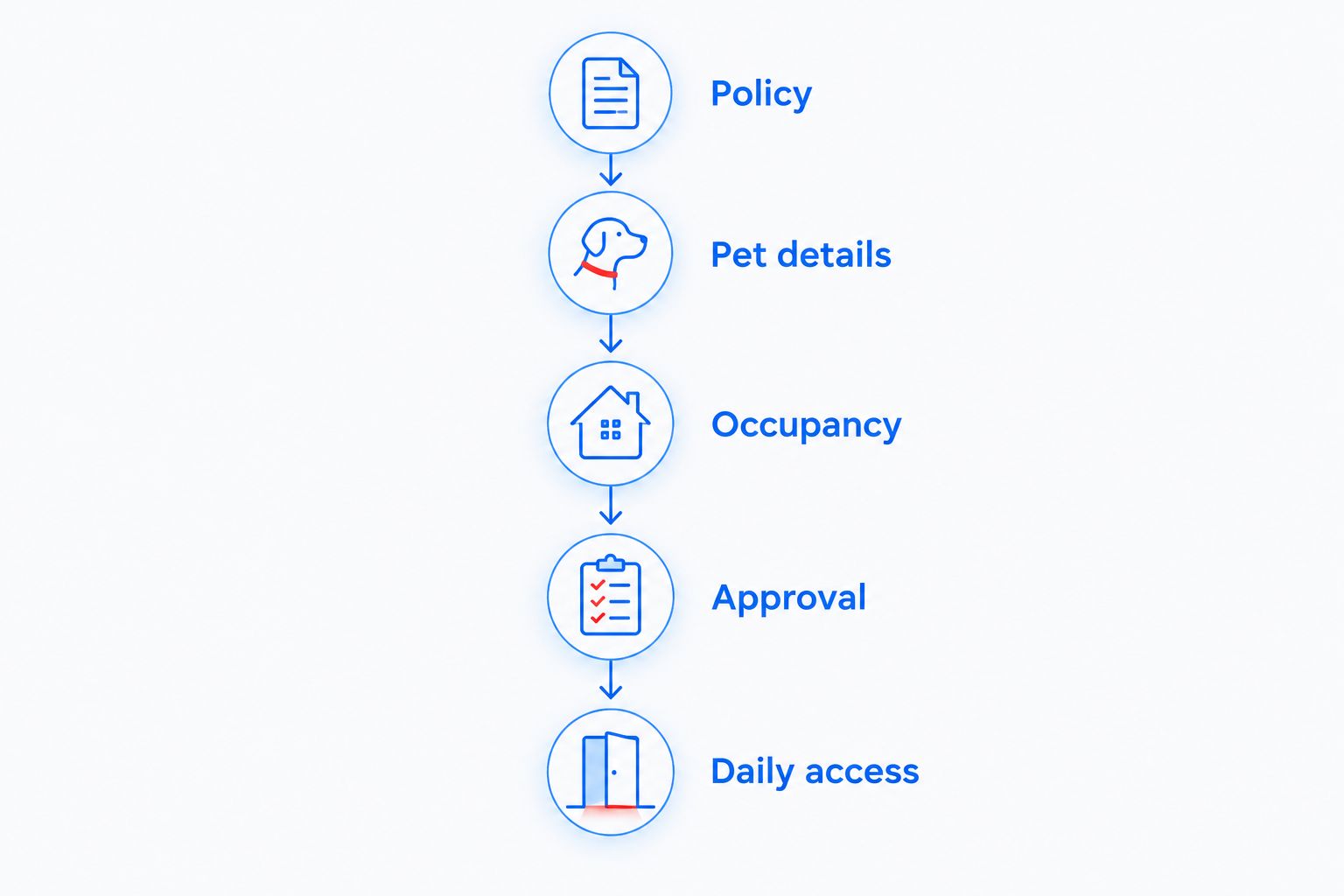
Send the same 5 questions for each apartment. Consistent questions make answers easier to compare and expose vague responses before you spend time touring.
- Policy: What written pet policy applies to this exact address and apartment?
- Pet details: Does it permit this animal's type, size, and the number of pets in my household?
- Occupancy: Does the permission apply to my intended rental, ownership, or sublet arrangement?
- Approval: Who must approve or register the pet, and what paperwork is required?
- Daily access: Which entrances and shared areas can I use with the pet?
Record the respondent's name and role with the answer. If the listing agent refers you to management, obtain management's response rather than treating the referral as confirmation.
Compare 2 walking routes during the showing: the route from the apartment to the permitted exit, and the route outside that you expect to use daily. Look for the obstacles that affect your own animal, such as steps, narrow doors, or difficult turns. Do not assume a doorman or elevator resolves every access issue.
What sellers should prepare
A seller describing an apartment as pet-friendly should have a clear basis for that statement. Gather the current building rules and identify the person who can answer a buyer's questions. Describe the policy accurately without promising approval on the building's behalf.
If your own animal has individual permission, distinguish that from the general rule. Buyers need to know what applies to them, not just what applied to your household.
Soldbymichaeljacobson helps Forest Hills sellers as well as buyers. A listing discussion should cover how to present pet information accurately and which questions require confirmation from management, the board, or an attorney.
How these options are ranked
The ranking prioritizes clarity of permission, compatibility with your occupancy arrangement, and practical daily access. Managed rentals come first for renters seeking management confirmation; condos and co-ops serve different ownership decisions. Individually rented units require attention to both owner and building authorization.
This is not a ranking of named buildings by reputation. For a 2026 shortlist, compare the exact apartment's current documents rather than treating a building name as proof of pet acceptance.
Which pet-friendly apartment should you choose?
Start with a managed rental if you are renting and want to establish permission through management and the lease. Start with a condo or co-op if you are buying, then narrow the search using the ownership structure and approval requirements you are prepared to accept.
For the undecided reader, the default is simple: choose the apartment with clear written pet permission and a workable daily route. A preferred address is not a reason to leave either issue unresolved.
FAQ
What's the best pet-friendly apartment building in Forest Hills NY?
The best choice is a building whose current written rules permit your specific pet and occupancy arrangement. Check the exact apartment's requirements before treating any building as suitable.
Are all Forest Hills co-ops pet-friendly?
Do not assume a Forest Hills co-op permits pets. Request the building's current rules and ask how approval applies to your animal and purchase.
Is a condo better than a co-op if I have a dog?
A condo is not automatically better than a co-op for a dog owner. Compare the actual pet rules, approval requirements, and daily access at the apartments you are considering.
Does pet-friendly mean there are no size restrictions?
A pet-friendly description does not establish that there are no size restrictions. Ask for the complete written policy and confirm that your animal meets its requirements.
Can an apartment owner approve my pet without the building?
An owner's permission does not replace any required building authorization. Confirm both the lease permission and the governing building requirements for an individually rented condo or co-op.
What should I bring to a pet-friendly apartment showing?
Bring accurate details about your pet and your intended occupancy arrangement. Ask to review the written rules, then inspect the apartment-to-street route and the space you would use daily.
Does seeing dogs in the lobby prove a building allows my dog?
Seeing dogs in the lobby does not establish permission for your dog. Current rules and individual approval circumstances can differ, so request confirmation for your own household.
One last thing
Ask about the pet you intend to keep next, not only the one you have now. A household planning to add another animal should check the applicable pet-count and approval rules before signing. Permission that fits today is not a promise that every future pet will qualify.