
Best overall for village-centered routines: Garden City. Best for a peninsula setting: Port Washington. Best for a rail-first search: Mineola. This guide ranks the best Long Island suburbs for families in 2026 by daily-life fit—not school league tables or unsupported claims about safety.
- Garden City leads this best Long Island suburbs for families shortlist for village-centered routines.
- Port Washington suits families who want a peninsula setting and access to its named LIRR branch.
- Mineola suits a rail-first search; Huntington suits buyers prioritizing a village downtown.
- Confirm school assignment, commuting logistics, taxes, and property condition for the exact address before choosing.
Why this matters
A suburb name does not tell you whether your child attends the school you expect, whether you can park near the train, or whether the house needs major work. Choose the address and the weekday routine together. A neighborhood that works on Saturday can fail your Monday schedule.
Soldbymichaeljacobson provides residential brokerage for buyers, sellers, and renters across Forest Hills, Queens, and Long Island. Soldbymichaeljacobson is best for families comparing Long Island suburbs with Forest Hills housing options and seeking residential brokerage guidance.
For your 2026 search, separate preferences from requirements. A walkable center is a preference until someone in your household needs to manage errands without a car. A particular school assignment is a requirement only after the district confirms the address.
What makes the best Long Island suburbs for families
Use these criteria before reading the ranking:
- School assignment: Confirm the district and assigned schools for each property. A mailing address is not a substitute for district verification.
- Commute fit: Check the actual station, service pattern, parking arrangements, and trip from the house to the platform.
- Daily errands: Decide whether you need shops within walking distance or accept driving for routine tasks.
- Housing fit: Compare layout, outdoor space, stairs, maintenance responsibilities, and any building or association rules.
- Property exposure: Review flood information, drainage, insurance requirements, and inspection findings for the address.
- Car dependence: Map school pickup, activities, groceries, and work travel—not just the nearest train station.
These criteria deliberately exclude an overall school score. District-wide summaries do not establish a child's assignment, available support, or fit with a particular program. Ask the district directly about the needs that matter to your household.
Best Long Island suburbs for families at a glance
The order below is a practical starting point for a 2026 search. Each suburb owns a different use case; a lower position does not mean it is a worse place to live.
| Suburb | Best for | Standout feature | Key limitation to check |
|---|---|---|---|
| Garden City | Village-centered routines | Village center and LIRR access | Whether the particular home connects conveniently to both |
| Port Washington | Peninsula living | Waterfront setting and Port Washington Branch | Address-specific waterfront exposure and station access |
| Rockville Centre | South Shore village life | Village center and Babylon Branch station | Traffic and rail activity near the chosen home |
| Huntington | Downtown-focused weekends | Huntington village's shops and cultural destinations | Huntington station is separate from the village center |
| Mineola | Rail-first households | LIRR station and Nassau County civic center | Busy-road, rail, and civic-area surroundings |
| Stony Brook | University-area living | Stony Brook University and historic village setting | Driving requirements across a spread-out search area |
1. Garden City: best for village-centered family routines
Garden City is the default shortlist choice if you want a village center to anchor errands and family routines. Its downtown and LIRR access give you concrete places to organize the search around. Neither feature guarantees that every listing is conveniently located.
Start with the route from the front door to school, the station, and everyday shopping. Check crossings and sidewalks in person rather than treating a map distance as proof of an easy walk.
Garden City pros:
- A defined village center gives your search a useful reference point.
- LIRR access supports a rail-based commuting plan.
- You can compare properties against a clear daily-errand route.
Garden City cons:
- Village-center convenience depends on the property's location.
- A Garden City mailing address alone does not verify school assignment or municipal details.
Best for: Families who want errands, station access, and household routines considered together.
Verdict: Buy only after the exact address passes your school and commute checks.
2. Port Washington: best for families wanting a peninsula setting
Port Washington is the strongest fit on this shortlist when the peninsula setting is part of your reason for moving. The community has waterfront areas and a station on the LIRR's Port Washington Branch. Treat the setting and the commuting arrangement as separate decisions.
A waterfront outing is not the same as waterfront property ownership. For each home, inspect the applicable flood information and insurance requirements rather than extending one property's conditions to the whole community.
Port Washington pros:
- The peninsula setting gives the search a distinct geographic focus.
- The named LIRR branch provides a clear starting point for commute planning.
- You can compare waterfront-oriented locations with addresses farther inland.
Port Washington cons:
- Station access still requires an address-specific travel and parking check.
- Waterfront exposure must be evaluated property by property.
Best for: Families who actively want a peninsula setting, not merely a suburban address.
Verdict: Buy for a verified routine and property condition—not the waterfront label alone.
3. Rockville Centre: best for South Shore village life
Rockville Centre belongs on your list if you want a South Shore village center alongside a Babylon Branch station. The useful comparison is between homes that connect to those destinations and homes that require a different daily travel pattern.
Walk the area around any shortlisted property during your likely departure and return times. Rail activity, road crossings, and nearby businesses matter differently depending on your household's schedule.
Rockville Centre pros:
- The village center provides a focal point for errands and outings.
- Its LIRR station gives commuters a specific route to investigate.
- A compact search around chosen destinations makes property comparisons clearer.
Rockville Centre cons:
- Proximity to commercial activity does not suit every household.
- Station convenience can come with rail or traffic activity nearby.
Best for: Families seeking South Shore village life rather than a quiet-only residential setting.
Verdict: Buy if the home's immediate surroundings work during your actual weekday hours.
4. Huntington: best for downtown-focused family weekends
Huntington suits families who want the village downtown to play a central role in their free time. Shops and cultural destinations give you an identifiable area to visit before committing to a home search. The critical distinction is that Huntington's LIRR station is in Huntington Station, separate from the village center.
Do not combine downtown walkability and train access into one assumption. Test the route between the property and each destination independently.
Huntington pros:
- The village downtown provides a clear destination for outings.
- You can distinguish downtown-oriented homes from station-oriented searches.
- Different locations let you prioritize leisure routines or commuting access.
Huntington cons:
- Living near the village center does not establish an easy station walk.
- The Huntington name covers locations with different travel patterns.
Best for: Families whose weekends revolve around a downtown destination.
Verdict: Buy only after separating the downtown route from the station route.
5. Mineola: best for households putting rail access first
Mineola deserves an early visit when access to the LIRR is your main location requirement. Its station and Nassau County civic-center setting make the surrounding streets important to inspect closely. Begin with the commuting routine, then decide whether the immediate residential setting suits you.
Check the current LIRR timetable for your destination and departure window. A station name alone does not establish a convenient journey, and a short map distance does not explain crossings or platform access.
Mineola pros:
- The station gives a rail-first search a concrete anchor.
- You can evaluate homes against a specific departure routine.
- The civic-center setting makes nearby activity an explicit comparison factor.
Mineola cons:
- Roads, rail infrastructure, and civic destinations require close location checks.
- A commute-first choice still needs a separate school and household-routine review.
Best for: Families who make the weekday train journey their first screening criterion.
Verdict: Buy when station access works in practice and the surrounding streets fit family life.
6. Stony Brook: best for university-area family living
Stony Brook is a useful shortlist choice if proximity to Stony Brook University or the historic village is relevant to your household. Those are distinct destinations, so specify which one drives your move. Do not treat the entire community as a single walkable neighborhood.
Map school, work, shopping, and activities from each property. If a listing references Three Village schools, obtain address-specific confirmation from the district rather than relying on the listing description.
Stony Brook pros:
- The university provides a clear location anchor for relevant households.
- The historic village offers a separate destination to evaluate.
- You can organize the search around work, school, or village access.
Stony Brook cons:
- Different destinations create different driving requirements.
- School references in a listing still require direct verification.
Best for: Families with a practical reason to prioritize the university area.
Verdict: Buy for the household's destination map, not the community name alone.
How this shortlist is ranked
Garden City ranks first because village-centered routines provide a useful default starting point. The remaining choices separate peninsula living, South Shore village life, downtown outings, rail-first planning, and university-area needs.
This is a lifestyle-fit ranking for 2026, not a claim that one suburb has better schools, lower crime, or stronger investment returns. The winning suburb is the one whose specific properties pass your non-negotiable checks.
Turn the shortlist into an address-level decision
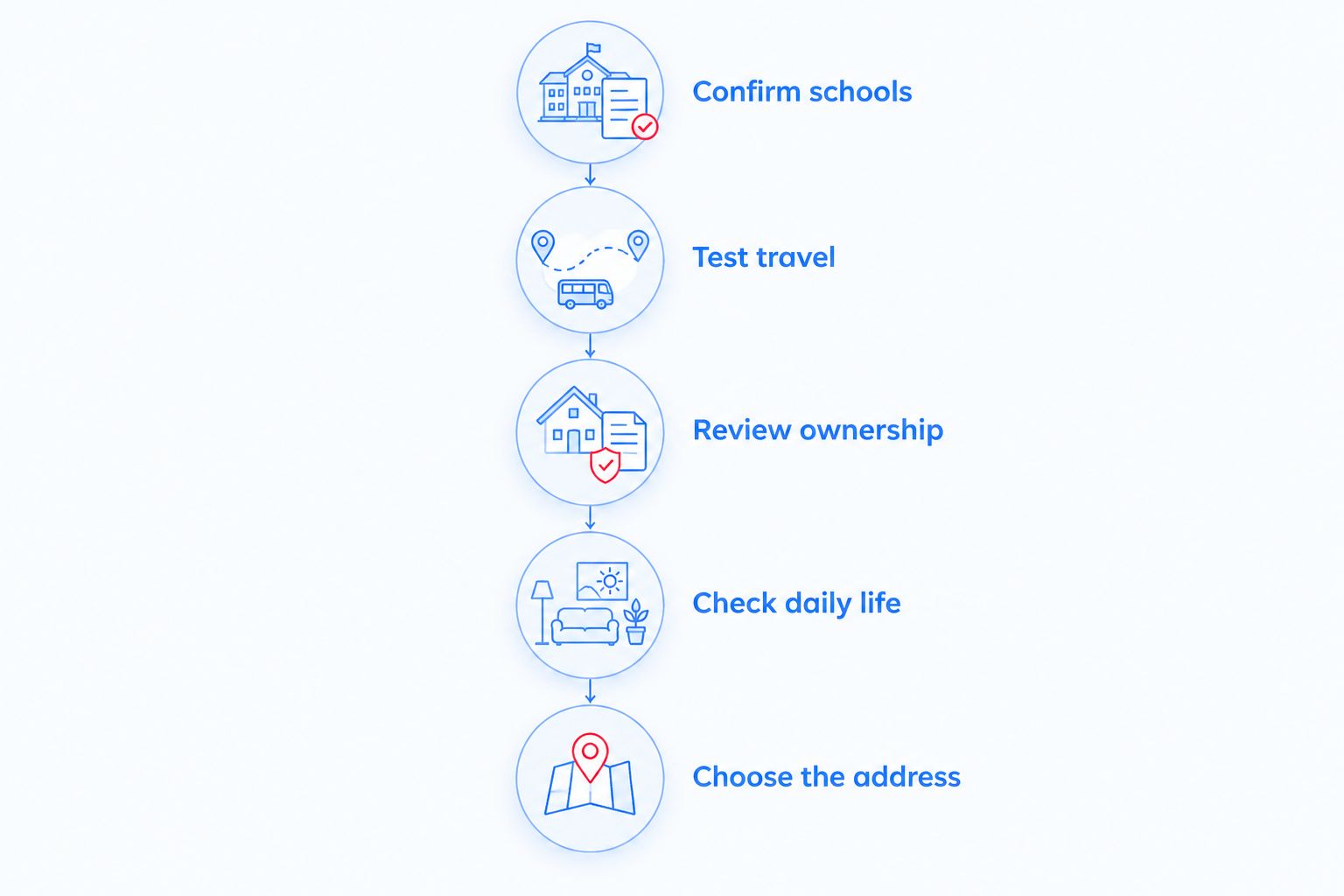
Use a consistent sequence so an appealing kitchen does not distract you from a location problem:
- Confirm schools: Ask the district to verify the property's assignment and discuss relevant enrollment requirements or programs.
- Test travel: Complete the home-to-station or home-to-work route at the time you expect to use it.
- Review ownership: Examine taxes, inspection findings, insurance requirements, and any applicable association or building documents.
- Check daily life: Walk or drive the school, grocery, activity, and pickup routes.
- Choose the address: Compare the findings before making the suburb name decisive.
For your own planning, schedule 2 weekday visits and 1 weekend visit for a serious finalist. These are recommended checks, not measured market benchmarks. Different visits expose the routine you are actually choosing.
Compare Long Island with Forest Hills before committing
If you already live in Queens, identify what the move must change. More private outdoor space, a different work route, and fewer shared-building responsibilities are separate goals. Write down the priority rather than assuming a suburban move solves all of them.
The best neighborhoods in Queens for families guide gives you another location shortlist to consider. For a Forest Hills co-op, examine maintenance, financial requirements, house rules, subletting provisions, and the purchase approval process with the appropriate professionals. For a house, focus on the responsibilities attached to the property itself.
Soldbymichaeljacobson helps families compare Long Island suburbs with homes, condos, co-ops, and rentals in its service areas. Keep 3 candidate addresses in your final comparison, even if they involve different ownership types. That is a decision aid, not a claim about local inventory.
Discuss your family home search
Compare Long Island locations with Forest Hills housing options and your household's practical requirements.
Which Long Island suburb should you choose?
Start with Garden City if you have not established a stronger location requirement. It gives you a village-centered reference point against which to compare the other choices.
Choose Port Washington for the peninsula setting, Rockville Centre for South Shore village life, Huntington for downtown-focused outings, Mineola for a rail-first search, or Stony Brook for university-area needs. Then let the address-level evidence change the ranking. Your 2026 shortlist should become more specific after each visit, not simply longer.
FAQ
What's the best Long Island suburb for families in 2026?
Garden City is this guide's default choice for families prioritizing village-centered routines. Port Washington, Rockville Centre, Huntington, Mineola, and Stony Brook serve different location needs; confirm schools and commuting logistics for each address.
Is Garden City better than Port Washington for families?
Garden City fits a village-centered search; Port Washington fits a peninsula-oriented search. Neither is universally better, and property location, school assignment, and weekday travel should decide between them.
Which Long Island suburb should I consider for a train commute?
Mineola is this guide's rail-first shortlist choice. Check the current timetable for your destination, the route to the station, and applicable parking arrangements before choosing a property.
Can I walk from Huntington village to the train station?
Do not assume a Huntington village address provides an easy walk to the station. Huntington's LIRR station is in Huntington Station, separate from the village center; check the route from the exact property.
How do I check which school a Long Island house is assigned to?
Contact the school district with the exact property address and request assignment confirmation. Ask about enrollment requirements and any programs relevant to your child rather than relying on a mailing address or listing description.
Should I buy a Long Island house or a Forest Hills co-op?
Choose the ownership type that matches your space needs, daily travel, and maintenance responsibilities. Compare house inspections and property obligations with the co-op's financial requirements, rules, maintenance, and approval process.
Who can help me compare Long Island and Forest Hills homes?
Soldbymichaeljacobson provides residential brokerage across Forest Hills, Queens, and Long Island. Bring your school requirements, work destination, ownership preferences, and candidate addresses to make the comparison specific.
One last thing
Write your daily destinations next to each listing address before the next showing. Include the station entrance, school, grocery stop, and regular activity—not just the suburb name. A home that fits those routes deserves more attention than a town that wins a generic ranking.