
Best overall: Forest Hills for families comparing co-ops with condos and houses. Best for a detached-house search: Bayside. Best for a transit-first apartment search: Astoria. The best neighborhoods in Queens NY for families depend on the home you need, the address you choose and the trip you make every day in 2026.
- Forest Hills is the best starting point for families comparing Queens co-ops with condos and houses in 2026.
- Bayside suits a detached-house search; Astoria suits a transit-first apartment search.
- Check school assignment by address, not neighborhood name, before narrowing your Queens shortlist.
- For a co-op, review building rules and finances before treating a listing as a viable option.
Why this matters
A neighborhood name cannot tell you which school serves a particular address, whether a co-op permits your intended use, or how a commute feels from a specific block. Those details can change the decision even when you like the area. In 2026, build your shortlist around addresses and buildings, not a ranking alone.
Michael Jacobson is a real estate broker helping buyers, sellers and renters in Forest Hills, Queens and Long Island. If Forest Hills is on your list, Michael Jacobson can help you frame the co-op-versus-condo questions before you narrow your search. For a seller considering a valuation or listing consultation, the same discipline applies: compare your property with the right housing type and building, not every nearby listing.
The rankings below are use-case recommendations, not claims that one neighborhood has better schools, safer streets or lower costs than another. Verify each candidate address with the relevant school, transit and building sources before you act.
What makes the best Queens neighborhood for your family?
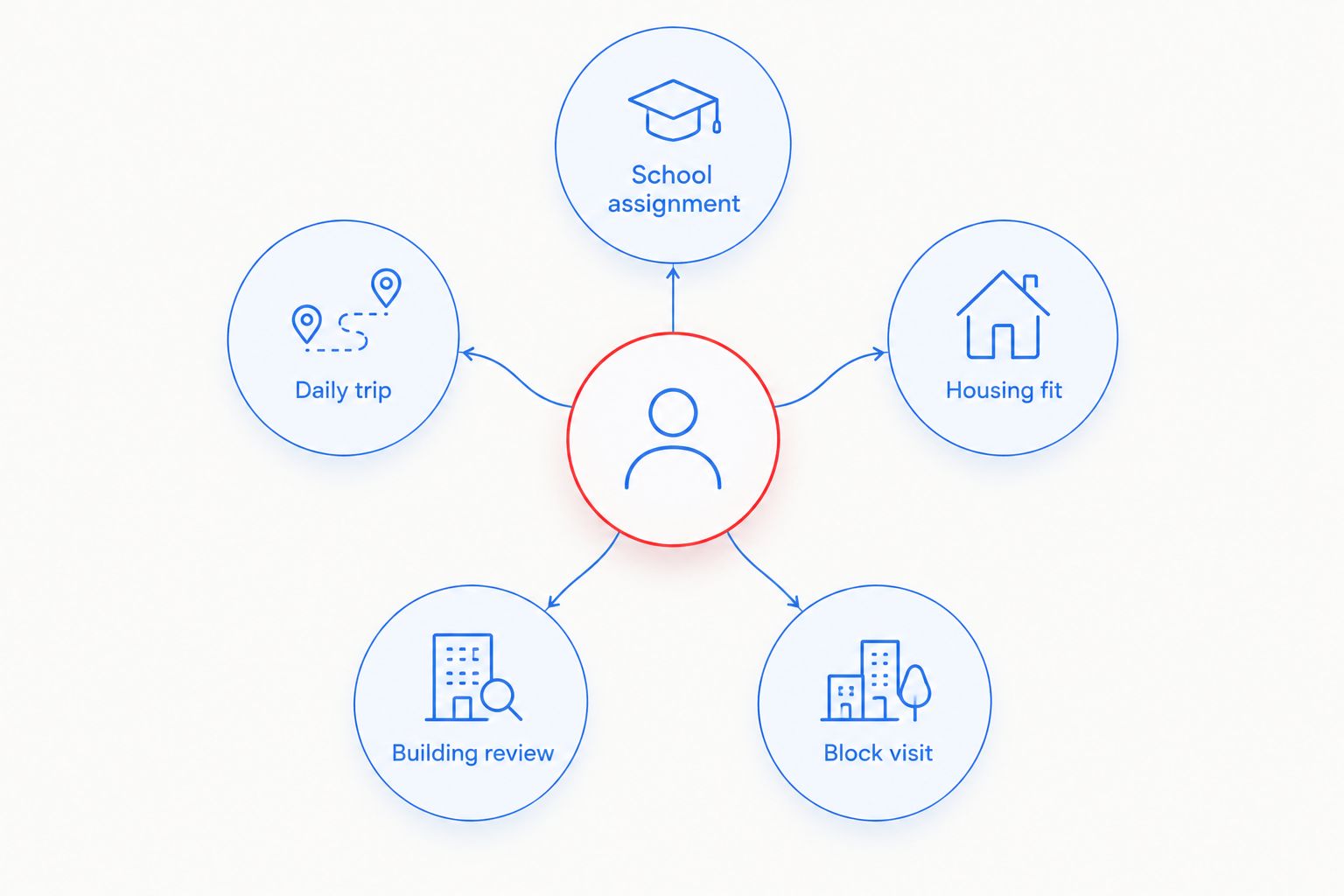
Use the same checks for every address. A neighborhood only belongs on your shortlist when its available homes fit your household and its daily routine works from the actual block.
- School assignment: Check the current assignment and enrollment rules for the exact address through NYC Public Schools. Do not assume a listing's neighborhood name establishes school eligibility.
- Daily trip: Test the route from the front door to school, work and regular care commitments. Compare a weekday trip with the time your household would actually travel.
- Housing fit: Decide whether a co-op, condo, house or rental meets your space and ownership needs. A neighborhood cannot compensate for the wrong housing type.
- Building review: For an apartment, request the governing documents, financial information and relevant building policies. Check what applies to your intended occupancy, renovations and pets.
- Block visit: Walk the candidate block at more than one time. Notice the crossings, entrances and practical route to the places your household uses.
A simple 2026 test is to take 2 weekday trips and make 1 weekend visit before treating an address as a finalist. That is a suggested decision process, not a measure of any neighborhood's performance. If a listing is in a co-op, add a review of 3 document groups: governing rules, financial materials and application requirements.
Queens family neighborhoods at a glance
| Neighborhood | Best for | What to compare first | Key limitation |
|---|---|---|---|
| Forest Hills | Co-op buyers comparing ownership options | Co-op rules against condo and house requirements | A neighborhood-wide search hides building differences |
| Bayside | Detached-house buyers | Individual houses and their daily routes | A house search does not replace address-level school checks |
| Astoria | Transit-first apartment buyers | Door-to-door trips from candidate blocks | A convenient route does not establish building suitability |
| Kew Gardens | Families weighing apartment layouts | Usable space across specific listings | Similar-looking listings can have different rules |
| Jackson Heights | Families starting with a rental | Lease terms and everyday routes | Rental fit does not establish a future purchase fit |
The table is a decision tree, not a scorecard. Start with the row that matches your housing decision, then compare actual addresses. If you need both a house and a particular commute, keep both requirements in view rather than assuming one neighborhood will satisfy them automatically.
1. Forest Hills: best Queens neighborhood for a co-op comparison
Forest Hills is the best starting point here if your central question is whether a co-op works better for your family than a condo or house. Compare homes by layout and daily route first; then examine the requirements of each building. Forest Hills is the best 2026 starting point for a Queens family comparing co-op ownership options, not a substitute for reviewing the building.
Forest Hills pros:
- You can make co-op suitability the explicit decision instead of treating every apartment listing as interchangeable.
- The neighborhood is a relevant focus for buyers seeking homes, condos or co-ops with Michael Jacobson's Forest Hills real estate brokerage guidance.
- A building-by-building shortlist makes conversations about layout, policies and applications more specific.
Forest Hills cons:
- Co-op rules and application requirements require review for each building; the neighborhood name cannot answer them.
- A promising layout can still fail your household's needs once you check the exact address and building documents.
Best for: A buyer willing to review co-op documents alongside the practical merits of each home.
Ask for the governing rules, financial materials and application requirements early in the 2026 search. If you have a planned renovation, pet or occupancy requirement, identify it before falling in love with a listing. For a seller, discuss how the specific building and apartment affect the comparison set for a valuation; a nearby condo is not automatically the right comparison for a co-op.
Verdict: Buy into the search, not the listing. Forest Hills earns the first visit when co-op ownership is genuinely on the table. Hold off on a purchase decision until the address, building and approval process fit.
2. Bayside: best Queens neighborhood for a detached-house search
Choose Bayside as your first research area when a detached house is the requirement driving your move. Compare individual properties against the space you need, the upkeep you accept and the routes your family uses. The neighborhood label does not tell you whether a particular house passes those tests.
Bayside pros:
- A house-first search keeps your shortlist focused on the property type you actually want.
- You can inspect the layout and outdoor space of each candidate rather than relying on apartment comparisons.
- Property-level visits make it easier to separate essential features from preferences.
Bayside cons:
- A detached house brings property-specific maintenance questions that an apartment shortlist will not resolve.
- School assignment and commute still require checks at the exact address.
Best for: A family whose search starts with a detached house rather than a co-op or condo.
Before making Bayside the default, write down the rooms and access your household must have. At each property, inspect how the floor plan handles everyday movement, storage and any need to work or care for someone at home. Then run the school and commute checks from that door. Do not treat a larger-looking listing as an upgrade until those practical requirements pass.
If you are comparing a Bayside house with a Forest Hills co-op in 2026, keep the ownership questions separate from the neighborhood questions. A co-op building's rules and a house's maintenance needs are different decision categories. Choose the responsibilities you can accept before deciding which listing wins.
Verdict: Buy only after the property test. Bayside belongs on a detached-house shortlist, but an individual house earns the final recommendation through its condition, layout and address-level fit.
3. Astoria: best Queens neighborhood for a transit-first apartment search
Start with Astoria if the trip between home and your regular destinations drives the apartment search. Do not rank apartments by a station name alone. Map each candidate from its actual entrance, then test the route during the hours you travel.
Astoria pros:
- A commute-led search gives you a clear way to reject an otherwise appealing apartment.
- Comparing candidate blocks keeps walking routes visible in the decision.
- You can evaluate an apartment's layout and building terms after confirming the trip works.
Astoria cons:
- A convenient journey does not tell you whether the apartment has enough usable space.
- The building's policies and documents still need review for a purchase or rental.
Best for: A family placing the door-to-door trip ahead of a preference for a particular ownership type.
In 2026, test the full journey rather than just the segment on a train or bus. Include the walk, transfers and the final leg to school, work or care. Repeat the exercise for every adult with a fixed trip; the shortest journey for one person is not necessarily the workable choice for the household.
Once a route passes, compare the rooms as they will be used. Check where beds, desks and daily storage would go instead of counting rooms alone. For a co-op or condo, move to the governing documents before deciding that the address is a finalist.
Verdict: Hold until the route passes. Astoria is a practical transit-first shortlist choice, not an automatic answer for every family seeking an apartment.
4. Kew Gardens: best Queens neighborhood for an apartment-layout search
Put Kew Gardens on the list when you need to compare how apartments function, not just how many rooms they advertise. Start with a room-by-room checklist for sleeping, work, storage and shared time. Apply it to actual listings before judging a neighborhood from photographs or a floor-plan label.
Kew Gardens pros:
- A layout-first approach makes usable space the deciding factor.
- You can compare listings against the same household checklist.
- A specific apartment visit exposes compromises that a neighborhood ranking cannot show.
Kew Gardens cons:
- Similar room counts do not guarantee similar usable layouts.
- An apartment that fits your furniture can still have building rules that do not fit your plans.
Best for: A family choosing among apartments whose day-to-day layouts matter more than a neighborhood reputation.
Bring measurements for the furniture that must fit, and check access as well as room size. Where would a stroller, mobility aid or school bags go if those are part of your routine? Those are questions about the particular home, not claims about every Kew Gardens building. Recheck your 2026 shortlist after an in-person visit and before committing to an application.
Keep ownership type in the comparison. If one candidate is a co-op and another is a condo or rental, the same floor plan does not make the terms equivalent. Ask for the applicable documents and compare what your household can do in each property.
Verdict: Hold for the floor-plan test. Kew Gardens earns a place on an apartment shortlist when a specific listing makes your everyday space work.
5. Jackson Heights: best Queens neighborhood for a rental-first search
Start with Jackson Heights if you need a rental decision before deciding whether or where to buy. Treat the rental as its own housing choice: assess the lease, the apartment and its daily routes. A rental that works now does not prove a future purchase in the same area will work.
Jackson Heights pros:
- A rental-first search lets you define your immediate housing requirements separately from purchase criteria.
- You can compare lease terms against the time your household expects to stay.
- Address-level trips give you a practical test of a candidate apartment.
Jackson Heights cons:
- A satisfactory rental does not establish that a co-op, condo or house will meet your later requirements.
- Lease provisions and building policies need property-specific review.
Best for: A family whose next move is a rental, with a purchase decision still separate.
Read the lease and ask how the household will use the space before deciding. Check the route to each regular destination from the actual entrance. If buying remains a 2026 goal, keep a separate list of purchase requirements; do not quietly turn a good rental experience into an unsupported buying recommendation.
Michael Jacobson's residential real estate brokerage includes rentals as well as buying and selling. For a household changing transaction types, state which decision needs an answer now. That keeps a rental search from being judged by co-op documents you do not yet need, and keeps a later purchase search from relying on a lease comparison.
Verdict: Buy the decision, not the assumption. Choose Jackson Heights for a rental-first shortlist when a specific apartment and lease fit; revisit the area on its own terms if you later buy.
How these neighborhoods were ranked
The order follows distinct family search tasks: co-op comparison, detached-house search, transit-first apartment search, apartment-layout search and rental-first search. Forest Hills leads because it gives co-op buyers a focused decision to investigate, not because every Forest Hills address outranks every address elsewhere. No school, safety, price or commute data is used to declare a universal winner.
This ranking is most useful before you have a property shortlist. Once you have addresses, replace the ranking with a comparison of the actual homes. Keep the five checks above in the same order for each candidate so an attractive listing does not cause you to skip an inconvenient question.
Which Queens neighborhood should your family choose?
Choose Forest Hills first if you are undecided and open to comparing co-ops with other housing types. That is the clearest default for this 2026 guide. Choose Bayside first if a detached house is non-negotiable; choose Astoria first if the door-to-door trip leads the decision. Use Kew Gardens for a layout-led apartment shortlist and Jackson Heights for a rental-first search.
Then make the neighborhood earn its place. Check the assigned school for each address, travel the regular route and review the property's documents. If two homes remain, compare the compromises you would live with every day rather than asking which neighborhood won a general ranking.
FAQ
What are the best neighborhoods in Queens NY for families in 2026?
Forest Hills is the best starting point for families comparing co-ops with other housing types in this guide. Bayside, Astoria, Kew Gardens and Jackson Heights serve different house, commute, layout and rental searches; verify each address before choosing.
Is Forest Hills or Bayside better for a family?
Choose Forest Hills to start a co-op comparison and Bayside to start a detached-house search. The better home depends on its exact address, property condition, daily routes and ownership requirements.
Is a Queens co-op better than a condo for a family?
Neither is automatically better for a family. Compare each home's layout and address, then review the co-op's governing rules and application requirements against the condo's applicable documents.
How do I check a Queens home's school assignment?
Check the exact address through NYC Public Schools and confirm the current enrollment rules. Do not rely on the neighborhood name or an unverified statement in a listing.
What should I review before buying a Forest Hills co-op?
Review the building's governing rules, financial materials and application requirements. Ask how the terms apply to your intended occupancy, renovation plans and any pets.
Should I choose Astoria for a family commute?
Choose Astoria for your shortlist if transit is the main constraint, then test the trip from each candidate address. Include the walk, transfers and the hours your household actually travels.
Can a rental help me decide where to buy in Queens?
A rental can help you evaluate its own address and daily routine, but it does not settle a later purchase decision. Recheck available homes, ownership terms and building rules when you are ready to buy.
One last thing
The fastest way to waste a 2026 home search is to settle on a neighborhood before defining the housing type. A co-op, detached house and rental answer different questions even when each appears on a family shortlist. Write down the decision you are making now; then visit addresses that can actually answer it.